Showing posts with label India Uncut. Show all posts

Thursday, November 3, 2011

India on the Human Development Index

Hindustan  Times  ,  Nov.3, 2011
Despite its high economic growth, India has been ranked lower than its neighbours, Pakistan and Sri Lanka, on multi-dimensional poverty index (MPI) and gender inequality index (GII) by the United Nations Development Programme.

The global Human Development Report released on Wednesday, however, ranks India 134 among 187 countries, higher than Pakistan but lower than Sri Lanka in the human development index (HDI).


Norway is top and Congo bottom of the index that measures healthy life, access to knowledge and a decent standard of living.

Wednesday, September 21, 2011

Put food on our plates


Indian  estimates of  poverty  range  from 270  million  to 450 million  people.  The  World  Bank  reckons 300  million  Indians  live  on  less  than  a  Dollar  a  day.
(Source Hindustan Times)

Yet   the  government  played   a  cruel  joke on  our  starving   masses  by  saying  that  anyone  who  earns   32 Rupees  (66 cents) a  day  is   not  poor. That  amount  can  only  buy  you  a  bowl  of  rice or  a  few   pieces   of  flat  bread (rotis) once   a  day.

How  can  our  rulers  who  have  stashes  of  money  in   their  banks  feel  the  rumblings  of  an  empty  stomach.

Reminds  me  of  passages  from  the  Old  Testament (Bible) when Israel  was  in  captivity. Both  the  remnants  and  captives  were  suffering.

Jesus had  compassion on  the  hungry  crowds  who  were following   him.


32 And Jesus called His disciples to Him, and said, “I feel compassion for the people, because they have remained with Me now three days and have nothing to eat; and I do not want to send them away hungry, for they might faint on the way.”

(Gospel  of  Matthew)

Jesus  performed  a  miracle  right there -  feeding  the  hungry  crowd  with  a  few pieces  of bread  and fish.

Dear  Lord  ,  Bless  my few  pieces  of  "fish and   bread", so  I   can  share  it   with  others  in   need.

 
(Photos by  my nephew  Ashish   and friend  Megan)

Megan  in front  of   a Government  building  in  New  Delhi  before  they  flew  back   to  Canada.

Saturday, September 10, 2011

India 's Black Wednesday- Delhi Terror

Today  America   remembers   and  mourns  for  the  tragedy which took  place  10  years   ago while  India   is  reeling  from  shock and  grief in   the  aftermath  of  another  terror attack  in    the  nation 's  capital.


A high intensity blast outside the Delhi High Court on Wednesday (Sept 7th) morning claimed 13 lives and left 76 injured. This is the second terror attack near the High Court in four months. The earlier attack in May was a low intensity one with no casualties. Harkat-ul-Jihad-al-Islami (HuJI), an Islamist fundamental outfit operating mostly from neighbouring Bangladesh, has sent out e-mails to several news organisation claiming responsibility for the attack.

The bomb was placed in a suitcase near gate number five of the high court where more than 200 people had gathered to collect passes to enter the premises. Wednesday is a busy day at the court since Public Interest Litigations are filed on the day. The injured were rushed to nearby hospitals — Ram Manohar Lohia Hospital, Safdarjung Hospital and Lady Hardinge Medical College and Hospital.

The blast caused a four feet deep crater at the spot, indicating it was a powerful bomb. The police said there were traces of ammonium nitrate and pentaerythritol tetranitrate and it appeared to be a sophisticated bomb

Security personnel secure the site of the blast outside the Delhi High Court in New Delhi on Wednesday . Subhav Shukla/PTI

There was no CCTV camera at the sensitive location. The Delhi Police has released sketches of two suspects based on descriptions provided by eyewitnesses. The metal detectors at the gates were also not functioning.

The e-mail sent by HuJI, says the death sentence awarded to Afzal Guru, the 2001 Parliament attack convict, be revoked. It threatened to target major high courts and the Supreme Court of India if it was not done. The veracity of the mail is yet to be ascertained. The case has been handed over to National Investigating Agency (NIA), which will supervise the probe with a special 20-member team, according to government sources.

“We take the mail very seriously,” said NIA chief SC Sinha.

Speaking in Parliament, Home Minister P Chidambaram said the government will not be intimidated by terrorist groups and it is “determined to track down the perpetrators of this horrific crime and bring them to justice”.

He regretted that the blast happened despite sharing of intelligence among several agencies. “Intelligence agencies constantly share intelligence inputs with Delhi Police. Intelligence pertaining to threats emanating from certain groups was shared with Delhi Police in July, 2011,” he said.

Reacting from Bangladesh where he is on a tour, Prime Minister Manmohan Singh described the as “a cowardly act of a terrorist nature”. He added, “We will deal with it… we will never succumb to the pressure of terrorism.”

“This is a long war in which all political parties, all the people of India have to stand united so that the scourge of terrorism is crushed,” he said.

Meanwhile, the BJP and the Left parties have asked the government to explain whether there was any intelligence failure.
(Source  Firstpost.com)

When  I  was  a  child the   words  terrorism and  terrorist were mere  shadows and  not  to   be  confronted  with. Now  they  have  become  words  ans  images  of   almost  daily  usage

Friday, September 9, 2011

Anna Hazare- India' s New Messiah

 Protests, rallies,marches,  demonstrations, strikes etc.  are  quite  common  in India,  the  world 's  largest  democracy. People  express  their  angst and  emotions through them. They  demand justice,  social action  and  government intervention. Most  of  this  public  activity  is  politically  motivated. Every  now  and then we  come  face  to  face   with   them.

But   the  month  of  August  saw  the  mother of  all  campaigns which  united  the   whole   of  India and  made  the   ruling  coalition government sweat profusely.

Anna  Hazare,  the  74  year  old  crusader against  corruption  lit  a  fire which   spread   all  across  India
Middle  class  Indian  society  joined  in to  oppose  corruption  and  scams which  have  caught several  politicians  and  VIPs  in their  net.
Mr  Hazare  went   on  a  fast  which  lasted   for  12  days  and  kept  everyone  on  tenterhooks and  glued  to  the  TV.
I  am quite   skeptical  of  the  Lokpal  Anti  corruption  bill which  is   the  bone   of  contention  between   the  government  and   social  and  civil  activists.
It  will  take  more  than  a  law  to  eradicate  or   at  least  lessen the  corruption an d moral  decay  which   has  seeped  into  our   society.  A change  of  heart  is  required.
I  took  some  photos   at  the  local  demonstration,  marches and   speeches  in  the  city  center.

(A  BBC  report)
Mr Hazare's campaign to strengthen an anti-corruption bill has received widespread support, with tens of thousands of people attending protests across the country.

The Indian government has been rocked by recent corruption scandals including an alleged telecoms bribery scam that may have cost the country $39bn (£23bn), suspected financial malpractice linked to the Delhi 2010 Commonwealth Games and accusation that homes for war widows were diverted to civil servants.

Critics of the government say the scandals point to a pervasive culture of corruption in Prime Minister Manmohan Singh's administration.


A recent survey said corruption in Asia's third largest economy had cost billions of dollars and threatened to derail growth.
A  model  of  Anna  Hazare

The  horrific   face   of   corruption
Social  activists taking  a  stand


The  young  and   the  old  join  in  patriotic  fever.


Campaign  merchandise. I  bought  a  cloth  cap.


A  local  politician giving   an  interview.

I   am  calling  Anna  Hazare  , India' s  new  Messiah  because  he  was  able  to  rally  toegther  his   countrymen  of   all  ages, backgrounds  and  walks  of  life  together  for   a  common  cause. They   found   a  role  model  in  him,  an  idealist,  a Gandhi like   hero.

Thursday, July 14, 2011

Haters of Good

We  are  living  in  a  very  violent  world. Hatred, like  garbage is  strewn across the  earth  invading  our  lives  and consciousness with its  stench  and disruption.

I  awoke to  news  of  different  kinds  of  violence.
Three  serial  bomb  blasts  in Mumbai , yesterday July 13th and a  news report of  an innocent  Pastor and  his  wife  being  beaten up and persecuted  for the  sake  of  Christ, in  the western part of  my  state.

In  the  evening I had  to  stand  up  to verbal resistance  from  Jags who is  our  church helper. He  is  a  good   man  but   suffers  bad  moods . I  try to overlook this  as he  does   a  lot  of  good.

All  this   disturbed  me  quite  a  bit  but   along   came  Milka (Pastor 's  daughter) who  wanted  my  help  with  her  English  assignments, letter  writing  and  a news  report. That  eased  my  mind.

She  told  me  something which  really  amused   me. Two  days  ago I  helped  her  with another  English  assignment. Her teacher was  so  pleased  with it  that  she  dictated it  to  the  entire   class  to  note  down. Har-har!
Coming back to what  I  was   writing  about .The  devil  is  not  at  rest  my  friends. He is  assaulting  the  earth in many  forms be  it terrorism,   angry  blood thirsty  mobs or  a  subordinate whom  you  have  to  deal  with  everyday.

The  Bible  gives a very  accurate  account to  today' s  world .

1But understand this, that in the last days there will come times of difficulty. 2For people will be lovers of self, lovers of money,proud, arrogant, abusive, disobedient to their parents, ungrateful, unholy, 3heartless, unappeasable, slanderous, without self-control, brutal, not loving good, 4treacherous, reckless, swollen with conceit, lovers of pleasure rather than lovers of God, 5having the appearance of godliness, but denying its power. 2  Timothy 3;1-5


Read  these  2  news  reports.  The  first one  is  from  the  BBC

Three near-simultaneous explosions have shaken India's commercial capital

Mumbai (Bombay), police say,
Twenty-one people were killed and 113 injured, said Maharashtra state's Chief Minister, Prithviraj Chavan
He called the explosions, during Mumbai's busy evening rush-hour, "a co-ordinated attack by terrorists"
One explosion was reported in the Zaveri Bazaar, another in the Opera House business district and a third in Dadar district in the city centre.

Police sources were reported as saying the explosions were caused by home-made bombs.

The attacks are the deadliest in Mumbai since November 2008 when 10 gunmen launched a three-day co-ordinated raid in which 166 people were killed  

At the scene
Zubair Ahmed
BBC News, Mumbai
--------------

Dadar is one of the old areas of Mumbai, in the middle of the city. The blast here happened in a very crowded area with lots of shops and residential buildings.
The blast here was not powerful. Police have said the explosion in Zaveri Bazaar was stronger.

Police say the timing of the blast - 1900 - is significant. This was the height of the evening rush hour - it was designed to cause maximum panic and casualties.
One person asked why Mumbai is always the target of attacks.
However, many of the people gathered here now are merely onlookers curious to see what has happened. People have come from nearby areas to see what is going on.
There is no evidence of real panic here
But in other parts of the city, the story is grimmer. There is panic and people are rushing back home.

Anger and curiosity in Mumbai

Prime Minister Manmohan Singh denounced the bombings and appealed to Mumbai residents "to remain calm and show a united face".

US President Barack Obama strongly condemned the "outrageous" attacks, and offered "support to India's efforts to bring the perpetrators of these terrible crimes to justice".

High alert

The latest explosions hit the city as workers were making their way home.

The first struck the Zaveri Bazaar at 1854 (1324 GMT), tearing through the famed jewellery market, according to police. A minute later, a second blast hit the busy business district of Opera House, in the south of the city. At 1905, the third bomb exploded in the Dadar area of central Mumbai.

Because the explosions occurred within minutes of each other, "we infer that this was a co-ordinated attack by terrorists", Home Minister Palaniappan Chidambaram told reporters.

Mumbai had been put on a state of high alert and a commando team was standing by, he said. Delhi, the capital, Calcutta and several other cities have also been put on alert.

Forensics teams have been sent from Delhi and Hyderabad to examine the explosion sites.

The majority of Mumbai's people live in slums, and millions live on the streets. This cannot make for a very happy place and the city's 'resilient spirit' has now become the cruellest Indian cliche

Soutik Biswas
BBC News, Delhi
------------------
The authorities have not yet said who they believe might be behind the explosions and no group has said it carried them out.

In Zaveri Bazaar, witnesses described a motorcycle exploding next to a jewellery shop. Mumbai Police Commissioner Arup Patnaik said a bomb had been left in an abandoned umbrella.

Photographer Rutavi Mehta told the BBC he was shopping nearby and heard the explosion. He grabbed his camera and ran to the scene.

"I took a couple of photographs. I think they might be too graphic for broadcast," he said.

"Bodies and limbs were strewn everywhere. People were crying and screaming. The area was packed with shoppers at the time of the blast. A few offered assistance to the blood-soaked victims, while others looked on in a state of shock," he said.

"It was totally chaos. There were pools of blood everywhere."

The second and most powerful blast was in the nearby Opera House district. Local media said it was planted inside the two-storey Prasad Chamber building.


Mumbai has been targeted many times in recent years, most notably in 2008 In the central Dadar district, the bomb tore apart a taxi that was parked next to a bus stop, witnesses told the BBC. It was unclear whether the explosives were planted inside the vehicle or in a nearby electricity meter box.

"I heard a loud explosion. And then I saw people with serious injuries lying in pools of blood," another person told the Times of India.

An unexploded bomb was also reportedly been found in Dadar.

The choice of locations makes it clear that the blasts were intended to cause maximum casualties, says the BBC's Soutik Biswas in Delhi.
But footage of one of the blast sites - a ripped-off cover of a bus shelter and a car with its glass shattered - points to a medium-level and possibly crude explosion, adds our correspondent.

According to some reports, the blasts came on the birthday of Mohammad Ajmal Amir Qasab, the sole surviving gunman from the 2008 attacks. But court records show his birthday to be in September.

Those attacks, which targeted two high-end hotels, a busy train station, a Jewish centre and other sites frequented by foreigners, were blamed on the Pakistan-based Lashkar-e-Taiba militant group.

Pakistan was quick to condemn the latest explosions, in a statement issued by the foreign ministry.
Peace talks between Pakistan and India have only recently resumed since they were broken off after the 2008 attacks.
Mumbai has been targeted many times in recent years.

As well as the 2008 attacks, co-ordinated blasts on seven of the city's trains on 11 July 2006 caused massive loss of life. More than 180 people were killed and hundreds wounded in those bombings, which were blamed on Islamist militants.

The city suffered four bomb attacks during 2003, including twin blasts on 25 August 2003 which killed 52 people.

In 1993, 257 people were killed and 700 injured in a series of 12 bomb blasts across the city. The attacks were allegedly ordered by the Muslim-dominated underworld in retaliation for Hindu-Muslim riots.


July 13, 2011:

Pastor, Wife Beaten in Uttar Pradesh

On 3 July, an angry mob accused Pastor John C.V Samuel from Assembly of
God's Church (AGC) of forceful conversion, beat him up and his wife in
Manpuri, Uttar Pradesh
The incident took place when Pastor Samuel, his wife and some believers went
to attend the burial service of Anil Saxena, who attended Pastor Samuel's
church for the past two years. Saxena committed suicide on Saturday night
after he had an argument with his father, reported our correspondent.
The angry mob suddenly rushed on the pastor and his wife, mercilessly beat
them up and falsely accused them of forceful conversion and of being the
cause of Saxena's death.


Saxena's wife intervened and told the mob that they went to the church by
their own free will and nobody has forced them.
The pastor's wife called the police by phone. The police arrived at the
scene and rescued the couple from the angry mob and took them to the
Pushpanjali Hospital, Agra where they were admitted.

Area Christian leaders submitted a police complaint but no actions have been
taken at press time.


Kindly pray for Pastor Samuel and his family and for peace in the area

An Appeal to write to Authorities

As concerned people, kindly write to the Chief Minister of Uttar Pradesh
appealing to them to safe guard the rights of the minority communities and
to give protection to churches against attacks and to take immediate action
against the perpetrators of violence.

Kumari Mayawati
Chief Minister of Uttar Pradesh
(O) Tel: (522) 2239296
(O) Fax: (522) 2239234
(R) Tel: (522) 221122
(R) Fax: (522) 220550

Issued By:
Rev. Dr. Richard Howell,
General Secretary
Evangelical Fellowship of India
New Delhi, India
Evangelical Fellowship of India (established 1951) is a charter member of
World Evangelical Alliance, an accredited NGO with the Economic and Social
Council of the United Nations
Please  pray  for  me.

Wednesday, July 6, 2011

India ranks 4th among the world most dangerous countries for women in the world

The  litany of perils for  Indian women  runs long.Murder,  rape, trafficking, abuse female foetuses  are  aborted   and  the  girl child  is   either  killed  or abandoned. Women in India  are  living  very  insecure  lives more so  single  women like  me.
Although India  has  made phenomenal progress  in the  field of  economic growth, education and  technology the  Indian  women has  been left  to  hide  her  face  in a  tattered  sari fearing  for  her  life.
All  this  in  a  country which  has  produced  outstanding women statesmen (if  I  may  say  so). Our  President  is  a  woman,  we  have several  women state  governors (chief  ministers) diplomats,   scientists  ,   fighter  pilots and  athletes etc.
Why?
The answer lies in  the  social-religious  world view of  my  countrymen. The  century old traditions incarcerate  women within  the  courtyard of  the  house.

The  status of   women improved with  the advent  of  Christianity and  western  influence. This  we  owe  to  our  colonists.

Crime  against  women  is  on   the  rise  in my  state  of Uttar Pradesh.  Women are  feeling  more  and more insecure  unsafe and vulnerable. It  is  worse for  a  single  woman  like  me. The  police  had  turned  rogue  in  my  state and  many  times  they  are  the  perpetrators  of crimes  against society. We  are  a very  ill-governed  state.  God 's  mercy  is  upon  us.
Here  are  2  stories  from the  news
STORY  # 1
STORY # 2


(These  paintings are  by MF Hussain 's
India 's  Picasso who recently died  in London
at the  age  of  95.
The last  painting is  entitled Mother Theresa)
Here  is   a report  from  The  Hindustan Times
Female foeticide, infanticide and human trafficking make India the world's 4th most dangerous country for women, with Afghanistan's violence and poverty taking it to the top spot, followed by Congo due to horrific levels of rape, a Thomson Reuters Foundation expert poll said on Wednesday.


Pakistan and Somalia ranked third and fifth, respectively, in the global survey of perceptions of threats ranging from domestic abuse and economic discrimination to female foeticide, genital mutilation and acid attacks.

"Ongoing conflict, NATO airstrikes and cultural practices combined make Afghanistan a very dangerous place for women," said Antonella Notari, head of Women Change Makers, a group that supports women social entrepreneurs around the world. "In addition, women who do attempt to speak out or take on public roles that challenge ingrained gender stereotypes of what's acceptable for women to do or not, such as working as policewomen or news broadcasters, are often intimidated or killed."


The poll by TrustLaw (www.trust.org/trustlaw), a legal news service run by Thomson Reuters Foundation, marked the launch of its new TrustLaw Women section, a global hub of news and information on women's legal rights. TrustLaw asked 213 gender experts from five continents to rank countries by overall perceptions of danger as well as by six risks.


The risks were health threats, sexual violence, non-sexual violence, cultural or religious factors, lack of access to resources and trafficking.

Some experts said the poll showed that subtle dangers such as discrimination that don't grab headlines are sometimes just as significant risks for women as bombs, bullets, stonings and systematic rape in conflict zones. "I think you have to look at all the dangers to women, all the risks women and girls face," said Elisabeth Roesch, who works on gender-based violence for the International Rescue Committee in Washington.

"If a woman can't access healthcare because her healthcare isn't prioritised, that can be a very dangerous situation as well."

Afghanistan emerged as the most dangerous country for women overall and worst in three of the six risk categories: health, non-sexual violence and lack of access to economic resources. Respondents cited sky-high maternal mortality rates, limited access to doctors and a near total lack of economic rights.


Afghan women have a one in 11 chance of dying in childbirth, according to UNICEF.


Democratic Republic of Congo (DRC), still reeling from a 1998-2003 war and accompanying humanitarian disaster that killed 5.4 million people, came second mainly due to staggering levels of sexual violence in the lawless east. More than 400,000 women are raped in the country each year, according to a recent study by US researchers.


The United Nations has called Congo the rape capital of the world. "Statistics from DRC are very revealing on this: ongoing war, use of rape as a weapon, recruitment of females as soldiers who are also used as sex slaves," said Clementina Cantoni, a Pakistan-based aid worker with ECHO, the European Commission's humanitarian aid department.


"The fact that the government is corrupt and that female rights are very low on the agenda means that there is little or no recourse to justice." Rights activists say militia groups and soldiers target all ages, including girls as young as three and elderly women. They are gang-raped, raped with bayonets and have guns shot into their vaginas.


Pakistan ranked third largely on the basis of cultural, tribal and religious practices harmful to women. These include acid attacks, child and forced marriage and punishment or retribution by stoning or other physical abuse. "Pakistan has some of the highest rates of dowry murder, so-called honour killings and early marriage," said Divya Bajpai, reproductive health advisor at the International HIV/AIDS Alliance.

Some 1,000 women and girls die in honour killings annually, according to Pakistan's Human Rights Commission.

India ranked fourth primarily due to female foeticide, infanticide and human trafficking. In 2009, India's then home secretary Madhukar Gupta estimated that 100 million people, mostly women and girls, were involved in trafficking in India that year.

"The practice is common but lucrative so it goes untouched by government and police," said Cristi Hegranes, founder of the Global Press institute, which trains women in developing countries to be journalists.


India's Central Bureau of Investigation estimated that in 2009 about 90% of trafficking took place within the country and that there were some 3 million prostitutes, of which about 40% were children.

In addition to sex slavery, other forms of trafficking include forced labour and forced marriage, according to a US State Department report on trafficking in 2010. The report also found slow progress in criminal prosecutions of traffickers.


Up to 50 million girls are thought to be "missing" over the past century due to female infanticide and foeticide, the UN Population Fund says. Some experts said the world's largest democracy was relatively forthcoming about describing its problems, possibly casting it in a darker light than if other countries were equally transparent about trafficking.

Somalia ranked fifth due to a catalogue of dangers including high maternal mortality, rape and female genital mutilation, along with limited access to education, healthcare and economic resources.


"I'm completely surprised because I thought Somalia would be first on the list, not fifth," Somali women's minister Maryan Qasim told TrustLaw. "The most dangerous thing a woman in Somalia can do is to become pregnant. When a woman becomes pregnant her life is 50-50 because there is no antenatal care at all. There are no hospitals, no healthcare, no nothing."


"Add to that the rape cases that happen on a daily basis, the female genital mutilation that is being done to every single girl in Somalia. Add to that the famine and the drought. Add to that the fighting (which means) you can die any minute, any day."


Poll respondents included aid professionals, academics, health workers, policymakers, journalists and development specialists.

Tuesday, June 28, 2011

Listen to the Falling Rain

My  cousin' s  teenage  daughter
baked this  cake  for  my mother.
They  visited  us   after  a  long time
that  made  it  even  more  special.

This  little fellow  was  enjoying
the  worship  music  at the  retreat.
He  brought  his  toy  guitar
to play  along.


The  advent  of  the  monsoons  has  brought  us
refreshment  and respite but  a rise  in  everyday  problems too.
Read  this  report  published
in  Times  of  India
 (  these miniature cement
sculptures are  by
a Western artist)


ALLAHABAD: Denizens of the city faced numerous problems owing to extensive waterlogging, as the rains lashed the city on Sunday night and Monday. It was a virtual doom, as many areas of the city were submerged in almost knee deep water.

As a result, traffic in different parts of the city was not only affected, but also came to a grinding halt, as people faced problems, while negotiating their way through the waterlogged streets. The rains have also categorically exposed the tall claims of the Allahabad Municipal Corporation regarding comprehensive arrangements to tackle the problem of waterlogging.

The condition of roads, which have been dug up for the laying of underground sewage pipelines further deteriorated. The slush caused hardships for the commuters and the schoolchildren going to their school.

The problem was acute in the areas of Rambagh, Bengali Tola, Kydganj, Chaukhandi, Allahpur, Mumfordganj, Baghambari Gaddi, Alopibagh, Chowk, Rani Mandi, Nakhas Kohna, Dara Shah Ajmal, Bahadurganj, Khuldabad, Muthiganj, Chak, Colonelganj, Subzi Mandi, Attarsuiya, Daraganj and other areas of the city. In Bengali Tola and Rambagh, people had to wade through knee deep water. Different lanes and bylanes of the locality was filled with water. People were keeping a close watch on the level of water, lest it enter their houses.

Speaking about the woes afflicting the residents of the area, Abha Dwivedi, corporator of Rambagh says, "There is problem of water logging every time, whenever there is rainfall. The problem is acute in the area of Bengali Tola, which always gets filled with water even during slight drizzle."She rued that the area is not properly cleaned, due to absence of adequate number of sanitary workers.

Besides, the area of Allahpur also witnessed heavy water-logging. Various lanes of Baghambari Gaddi Housing Scheme was filled with water. Due to the non cleaning of some portion of Dandiya Nala, water did not drain out and it caused water logging in some portions of Allahpur. The problem was more acute in Alopibagh, where the work of constructing sanitary chambers is going on. A truck turned turtle here causing traffic problems in the area.
Roads of some areas of the city including Ashoknagar have also caved in. Some of the cattle in the area also died due to electric current during the rains.

At Mumfordganj, residents of MIG Colony complained that silt along the main drain of the locality has not been lifted. The silt has once gain fallen into the drain due to which there was problem of water-logging.

The problem deteriorated in Dara Shah Ajmal locality, where water entered in many houses of the area. This area always faces this problem as it is located on a lower topography compared to the surrounding localities.
(Times  of  India)
___________________
I  am  not  venturing  out  much because  the  slippery  roads  and  puddles   makes  walking   difficult  for  me. I  don 't   have  a  car. A helper  does  small  jobs  for  me.

But God' s  grace  is  sufficient  for  us . Like  gentle  rain drops   of God 's  grace  fails  into  our  lives.

Last  week   the  government  announced  another increase in fuel  and  cooking  gas  prices. Which   means prices  of   all  essential  commodities  and  food   will  jump  up  again. The  whole  of  India  is in  uproar  at this. Transport  will  become  more  expensive. The  hole   in  my   pocket  is  getting   larger.

A  Christian brother who  runs  an  orphanage in Calcutta  says   it  will  be  difficult to  feed  his  90  children. All  protein based  food has  become  very  expensive.  Its  so  hard  for   the  destitute and  backward people. The  rich  don 't  care.  They  have  plenty  in reserve.

According  to  UN  surveys India  ranks  high  on  the  world  hunger  index.  More  people   go  to  sleep  hungry  in India  than on  the   continent of  Africa they  say.

Read   an  IBN 7  news report HERE


Well,  all  this   is  pretty  depressing  so  let  me  end   with this  video. I  used  to   listen to  this  rain song on  SLBC (Shri  Lanka Broadcasting  Cooperation  Radio) in my  teens.  I discovered  it  on  YouTube. Maybe  you  remember  it  too.


Thursday, April 7, 2011

India dwells in her villages

India  dwells  in her  villages- Gandhi

Scattered throughout India are approximately 500,000 villages. The Census of India regards most settlements of fewer than 5,000 as a village. These settlements range from tiny hamlets of thatched huts to larger settlements of tile-roofed stone and brick houses. Most Indian villages are small; nearly 80 percent have fewer than 1,000 inhabitants, according to the 1991 census. Most are nucleated settlements, while others are more dispersed. It is in villages that India's most basic business--agriculture--takes place. Here, in the face of vicissitudes of all kinds, farmers follow time-tested as well as innovative methods of growing wheat, rice, lentils, vegetables, fruits, and many other crops in order to accomplish the challenging task of feeding themselves and the nation. Here, too, flourish many of India's most valued cultural forms.


Viewed from a distance, an Indian village may appear deceptively simple. A cluster of mud-plastered walls shaded by a few trees, set among a stretch of green
 or dun-colored fields, with a few people slowly coming or going, oxcarts creaking, cattle lowing, and birds singing--all present an image of harmonious simplicity. Indian city dwellers often refer nostalgically to "simple village life." City artists portray colorfully garbed village women gracefully carrying water pots on their heads, and writers describe isolated rural settlements unsullied by the complexities of modern urban civilization. Social scientists of the past wrote of Indian villages as virtually self-sufficient communities with few ties to the outside world.

In actuality, Indian village life is far from simple. Each village is connected through a variety of crucial horizontal linkages with other villages and with urban areas both near and far. Most villages are characterized by a multiplicity of economic, caste, kinship, occupational, and even religious groups linked vertically within each settlement.
(The  above  article  has  been  taken  from Cyber Essays)
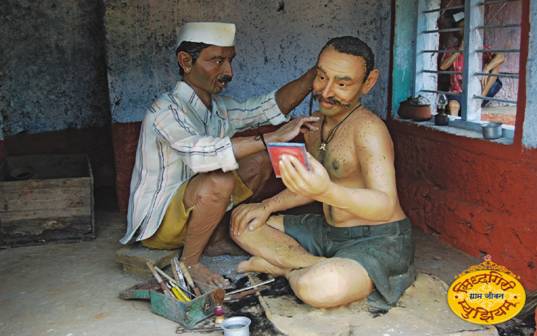
My friend Sita  Henderson  emailed  me photos  of  the  Siddhagiri  Wax Museum depicting  an  Indian  village  in South India. I  never  knew  India  too  had  a  wax  museum and  such  a  good  one  too. I  found  their  website .  You  can  read more  about  the  museumHERE HERE.

Modernization has  reached   most  Indian  villages , so  the  methods  of  agriculture  and living  are not  as  ancient as  seen  here - although  there  are  pockets  of  neglect and  backwardness.

Modern  machinery and  farming   expertise  is  freely  available.  The  electrified  villages  have  satilite  television,  Internet  and   mobile  phone  services. Agriculturists  in the western  part  of  my  state are  very  wealthy.
At the  same  time  progress  and  modernization has  to reach   everyone  equally. There  are  many  parts who  have yet  to see the  sun  of  prosperity rise  over them.

The  figures  of  the  wax  museum are  very life like  and skillfully crafted. They  show the cultural,  social, religious and  agricultural aspects  of  Indian  villages.
Ploughing a  field.


Drawing  water

Many areas  have  water  scarcity.
Wells  come in use.
Indian  agriculture  suffers  quite  a  bit 
as it  depends on the monsoons
and  natural  rain  for  irrigation.

A  village  barber.

They  are  found  in the  city  too.


A village  astrologer or  Pundit
is  an  important man to  be
consulted about  various activities of   life.
Horoscopes  and  auspicious  dates have to be
determined.

I  am not  sure  but this  one  could 
be  showing the  ancient  oil press.
The  oxen move  round operating
the  oil press.
Of course  now  we have the  electric ones.

The  bangle lady  goes from  house  to house
selling her  wares  and  putting  on  multi colored
glass  bangles  on  ladies.
Married women must  wear  bangles.
Bare  wrists  are not   considered  nice.
This  young  woman nurses  her  baby
while  the  bangle  lady obliges  her.


The  Potter
Hand  operated  machine.
I  am not  sure  what  is  its  purpose.
Someone  can apprise  me.

Cattle  byre

Vegetable  shop

Make  stone ware  objects  and utensils

Basket  weavers

Seamstress

A  typical money lender.
They  are  very  shrew  d  and  ambitious  men
and  poor unsuspecting  peasants  are  cheated by  them.

A herbalist , apothecary or
ayurvedic physician.
They use  various  herbs,oils  and  massages
to   treat  their  patients.

A gold  and silver  smith.
Gold and  silver  ornaments  are
the  pride an d joy of an  Indian   woman.
Even   the poorest  of  the  poor must  have  some
thing of  value  to   boast of.


A  grocery  store.

A  family  relaxing   together

Singing  a  religious  song  for  a  festival.

Iron forge

Farrier


Making   metal  utensils.


A  visit  to the  temple
with   articles  of  pooja.

A woman   displaying  her  henna  tattoos.
Its customary  to  have them  applied for
festivals  and   weddings.

The  village  council  or  panchayat.
It  plays   a  very  important   role
in keeping  l;aw and  order  at  the  grass root  level and 
settling  petty  disputes.
Five village  elders  and  voted  into  this  governing  body.
They  are  given  judicial  rights  by  the  government.

This  was  a  little  glimpse of
an  Indian village.
This  museum ha s tried  to   preserve
the  older   traditional senario.
Hope  you liked it.
++++++++++++++++++

Thank you  for your  prayers  for me and  my  church.
The  Lord 's hand  of  grace and  mercy  is  upon us.


Related Posts Plugin for WordPress, Blogger...